
Want to Bridge a Divide? Stop and Sense the Social Field.

Stopping to Sense the Social Field. Photo by RODRIGO GONZALEZ on Unsplash
In these stressful and polarized times there’s a lot of talk about bridging social divides. And it’s become more and more accepted that embodiment practices can help us stay present with our sensations and emotions in these difficult situations. The idea of ordinary people using breath work, meditation or visualizations used to be met with raised eyebrows. But nowadays all of these are easily available, offered across so many organizations, platforms and bodies of expertise. I myself have a suite of video groundings available, developed during the collective trauma of the Minneapolis “metro surge.”
But there’s another, deeper step we can take, one that allows deeper change: Social Field Sensing or relational awareness. It’s less commonly known. Yet, it’s the next ripple out in the pond, an additional skill that is crucial if we want to walk our talk. In my experience, the lack of ability to tap into this is a key factor in the ongoing othering we experience in groups of all sizes.
Systems, Social Bodies and Fields
But let me back up and define a few things. I teach and facilitate using Social Presencing Theater (SPT), an emerging discipline developed by Arawana Hayashi at the U.School for Transformation. It’s the cutting edge of systems change work that extends Peter Senge’s concept of Systems Thinking to Systems Sensing. It starts from the idea that there are some systemic problems we can’t think our way out of, but must sense into.
Especially for systems that involve human beings, not just widgets or code, the “go fast and break things” approach is disastrous.
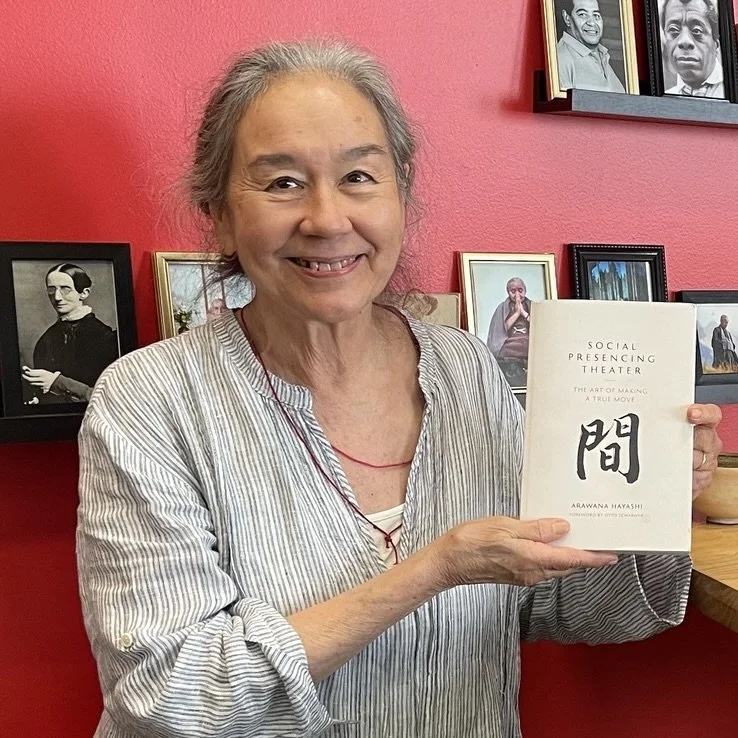
Photo by Jonathan Bucki, all rights reserved
Social Presencing Theater is a set of practices that teach us to be present and sense into these situations. It’s practiced on the three levels of:
Your personal body;
The “Social body” or any assembled group of people you find yourself in;
The “Earth body” we all share.
By looking at systems as bodies and providing embodiment practices for them, SPT functions as bodywork for groups, organizations or communities. Like personal bodywork, it can help realign parts of the whole, release stored tensions, and surface new possibilities. In fact the name contains all of this:
Social - a group activity
Presencing - a combination of Present + Sensing
Theater - from the Greek – a place where the invisible and ineffable becomes visible and tangible.
Social bodies (be they a family at home, children in a classroom, protesters filling a street, or coworkers in an office break room) collectively generate a social field. You have felt a social field if you’ve ever heard a speaker tell a moving story that left the room silent. Or if you’ve ever walked into a tense situation and sensed the vibe of it before you understood what it was about. It’s the ability to “read the room,” to notice and get a gut-level read on the invisible vibe of a group. Think of Social Field Sensing as being tuned in to this energy.
Common (Non)Sense
Have you ever seen someone make a social gaffe and not understand the response they get? If so, you’ve experienced social field non-sense at play. It’s literally nonsense - the person’s brain isn’t able to make sense of what’s gone wrong or why.
And it’s no wonder. Living as a member of the dominant culture means we can easily live our lives without needing to sense what’s going on energetically in a room. When I tell a joke and my peer group laughs it’s no surprise. We’re similarly situated in the culture. If I’ve grown up around similar people, I learn to expect a response that fits my own mindset. When I then arrive in a room where my stories fall flat, it’s mystifying. There could be many reasons - have I ignored a hurtful chapter of history? Stepped across a cultural taboo? Is my audience simply too young to get my reference to a fax machine or cassette tape? Or did I have the unfortunate timing to enter the room just after someone received terrible news? Since my remarks have rarely fallen flat, I’ve had little practice tuning in to the why. I’ve also had no reason to stop and feel the room before I open my mouth.
“Since my remarks have rarely fallen flat, I’ve had little practice tuning in to the why. I’ve also had no reason to stop and feel the room before I open my mouth.”
And this is where the intersection with bridging social divides begins. Not sensing a Social Field means that I don’t know when I’m dominating the dialogue, or when I’ve made some out-of-bounds comment. Listen to the apology attempts of anyone in a dominant group toward anyone they’ve marginalized - from #MeToo to microaggressions, the apologizers commonly express that they had no idea the harm they were causing. As someone whose upbringing was squarely in the dominant culture, I personally have had to learn to sense into social fields that included a more varied range of humans. I had to get over my surprise and learn to expect that there are alternate ways of responding to what I have just said or done. The good news is that these now come to me naturally. The way I learned them was through practicing sensing fields via SPT.
From Nonsense to Othering
At its worst, this non-sensing allows us to straight up ignore people who are deemed inconvenient in some way. That guy sleeping on the sidewalk? I see him, yet I don’t allow myself to sense him as a human being, which might generate some uncomfortable feelings. This withdrawal from noticing others results in apathy (from a-pathos, without feeling). Actively working to solve the root problem is then out of the question.
During the pandemic when many social divides were exposed, Tufts University College of Civic Life Dean Dayna Cunningham placed this ability to look away in the parlance of the times: the “other kind of social distancing.” Taking it farther, she connected the dots between this and dehumanization, framing it as a set of cultural agreements that we will not pay attention to people whom we’ve decided are “not as human as we are.” I will add that those agreements are much more than unspoken — they are unseen and un-sensed, embedded in structures handed down to us over generations. On the receiving end, the lack of attention creates a kind of “structural violence” that underlies outright bigotry and physical violence. For those of us who participate in these agreements, they function as a way of anesthetizing ourselves to the inequities around us — again with the a-pathy, non-feeling.
This fits with Cultural Somatics practitioner Tada Hozumi’s idea of privilege as an “institutionalized dissociative mechanism,” baked into the dominant norms of any culture. His theory is that in order to undo the othering stance of privilege, we must “re-inhabit ourselves” by cultivating awareness of our entire bodies.
“To fully escape our numbness, we must also re-inhabit our social bodies.”
As an SPT teacher I see that awareness of our personal bodies is a great first step, but that to fully escape our numbness we must also re-inhabit our social bodies. As a dancer there were many years when I had exquisite personal body awareness but could still manage to be numb to the guy on the sidewalk. I, like so many people, needed to cultivate awareness of my entire community, including those at the margins. We can do this starting with the people in our immediate environment - at home, in the supermarket, at the airport, on a downtown street. Of course this will bring us out of our anesthetized state and cause a move from apathy to empathy. It can be painful, particularly if, on the level of the personal body we’ve been ignoring our emotions. The beauty of SPT is that it offers work in the personal body that helps us metabolize and develop stamina for the difficult feelings we experience once we allow inequities within the social body into our consciousness.
For me, as I developed my relational awareness along with my ability to rest my attention on my own emotional responses, I found myself able to lead in an adaptive way, moving up and back as the Social Field requires. When there’s friction in a group, I feel less pressure to quickly react or to endlessly brood over the exact right thing to say. Instead I can sense into my body and the social field and allow a response to arise. SPT calls this sense of deeply knowing what to do in the moment “Action Confidence.” And accessing this is more than worth giving up the perceived safety of my numbness. Honing my Social Field Sensing has been that crucial next step toward walking my talk in bridging social divides.
If you want to develop your ability to stop and sense the social field, I’ve created a Solo Field Awareness practice. I also offer classes online and in person, so watch my Classes & Events page. I’d love to have you practice with me!